Tenish
A daily numerical trivia game where getting close counts.
- Status
- Live
- Launched
- September 2026
- Built with
- Next.js, TypeScript, Tailwind CSS, Python, Vercel
- Links
- Live site

Overview
Tenish is a daily numerical trivia game where getting close counts. Every day there's one question with a numerical answer, and five guesses to get as close to it as you can.
It's deliberately small, and one of the clearest examples of what I enjoy building: a simple idea, a defined problem, a working product, and then finding out what happens when you put it in front of people.
The problem
Tenish started with a simple question: what if a trivia game didn't require you to know the exact answer?
Most numerical trivia has a problem. You either know the answer or you don't. But estimating can be fun in its own right. You probably don't know exactly how tall the Eiffel Tower is, how many episodes a TV series had, or how far a planet is from the Sun, but you might have a surprisingly good idea.
Tenish turns that uncertainty into the game.
What I built
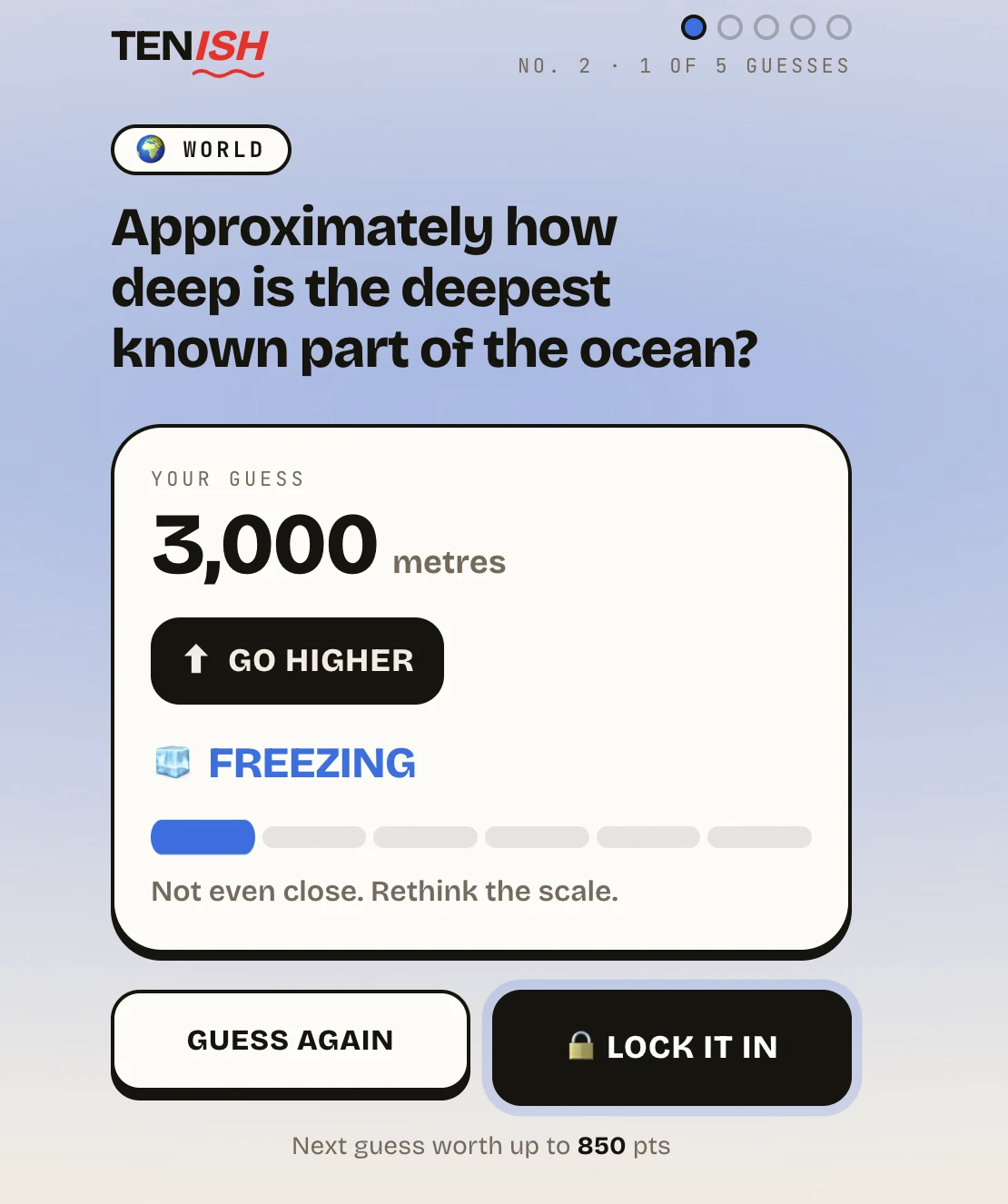
Every day, Tenish presents one numerical trivia question. Players get five guesses to get as close as possible to the correct answer, with feedback after each attempt so they can adjust their estimate and work toward it.
The result sits somewhere between trivia, estimation and deduction, and it's deliberately quick: one question, once a day.
Key features
- One daily question
- Low commitment, and a reason to come back tomorrow.
- Five guesses
- Enough room to reason about the answer, not enough to brute-force it.
- Feedback on every guess
- Go higher or lower, plus a temperature from freezing to hot, so each guess informs the next.
- Points and accuracy
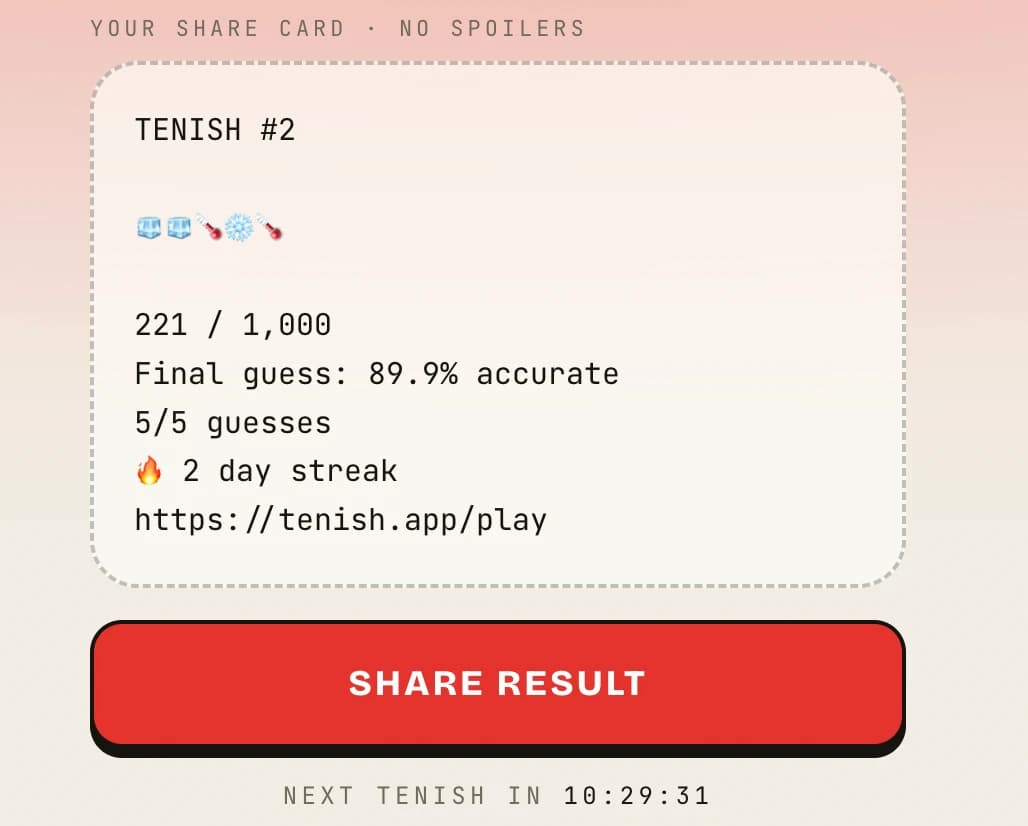
- Scored out of 1,000. Each extra guess is worth fewer points, and the final guess gets an accuracy score.
- Sourced answers
- Sources are kept alongside questions, so answers can be verified.
- Spoiler-free sharing
- An emoji trail of your guesses, your score and your streak, without the day's answer.
- Streaks
- A daily streak for coming back tomorrow.
- No account needed
- Open it, play, done.
Interesting problems
Designing the core loop
The most important part of Tenish wasn't adding features. It was making the basic interaction satisfying enough to stand on its own: question, estimate, feedback, adjust, reveal, share.
Question design
A game like this depends heavily on its questions. Each one needs to be interesting even if you don't know the answer, possible to make an educated guess about, based on a reasonably definitive number, clearly worded, properly sourced, and different enough from the last that the game doesn't become predictable. That made the question system part of the product, not content bolted on after the game was built.
Sharing without spoilers
Daily games benefit from players comparing results, but sharing can't reveal the answer to people who haven't played yet. Tenish's shareable results show how someone performed without exposing the solution, which adds a small social loop to what is otherwise a single-player game.
Launching it
Rather than waiting for a big marketing plan, I put the working game in front of people through my own network and online communities, and watched what happened. Players started completing the daily question and sharing screenshots of their results. Since then I've been testing different discovery channels, including professional networks, social media, workplace communities and game-focused communities, to see how a small independent product finds its first users.
Decisions & trade-offs
Five guesses, not unlimited
Limiting guesses creates room to reason about the answer without letting anyone brute-force it indefinitely.
Intentionally small
Tenish doesn't need accounts, complicated progression systems or an endless stream of content to do its job. The constraint is the product: one question, five guesses, come back tomorrow. The challenge is keeping that simplicity while still making the game feel polished.
Outcome
Tenish went from an idea to a live daily game at tenish.app, with real players completing the daily challenge shortly after launch.
What I learned
Tenish reinforced something I keep finding while building projects: shipping changes the questions you're solving.
Before launch, the questions are about the product. Does the game make sense? Is the feedback useful? Are the questions good? Does sharing work?
After launch, entirely different ones appear. How do people discover it? Do they come back? Where are players coming from? What makes someone share their result? Which questions are satisfying rather than frustrating?
It gave me a compact product where I could work through the whole cycle: idea, mechanics, implementation, content, launch, distribution and iteration.
Tech
- Next.js
- TypeScript
- Tailwind CSS
- Python
- Vercel
Screenshots