Acorn
A simple family banking app for managing allowances, spending, savings goals and investments.
- Status
- Personal use
- Launched
- August 2026
- Built with
- Lovable, AI-assisted development
Overview
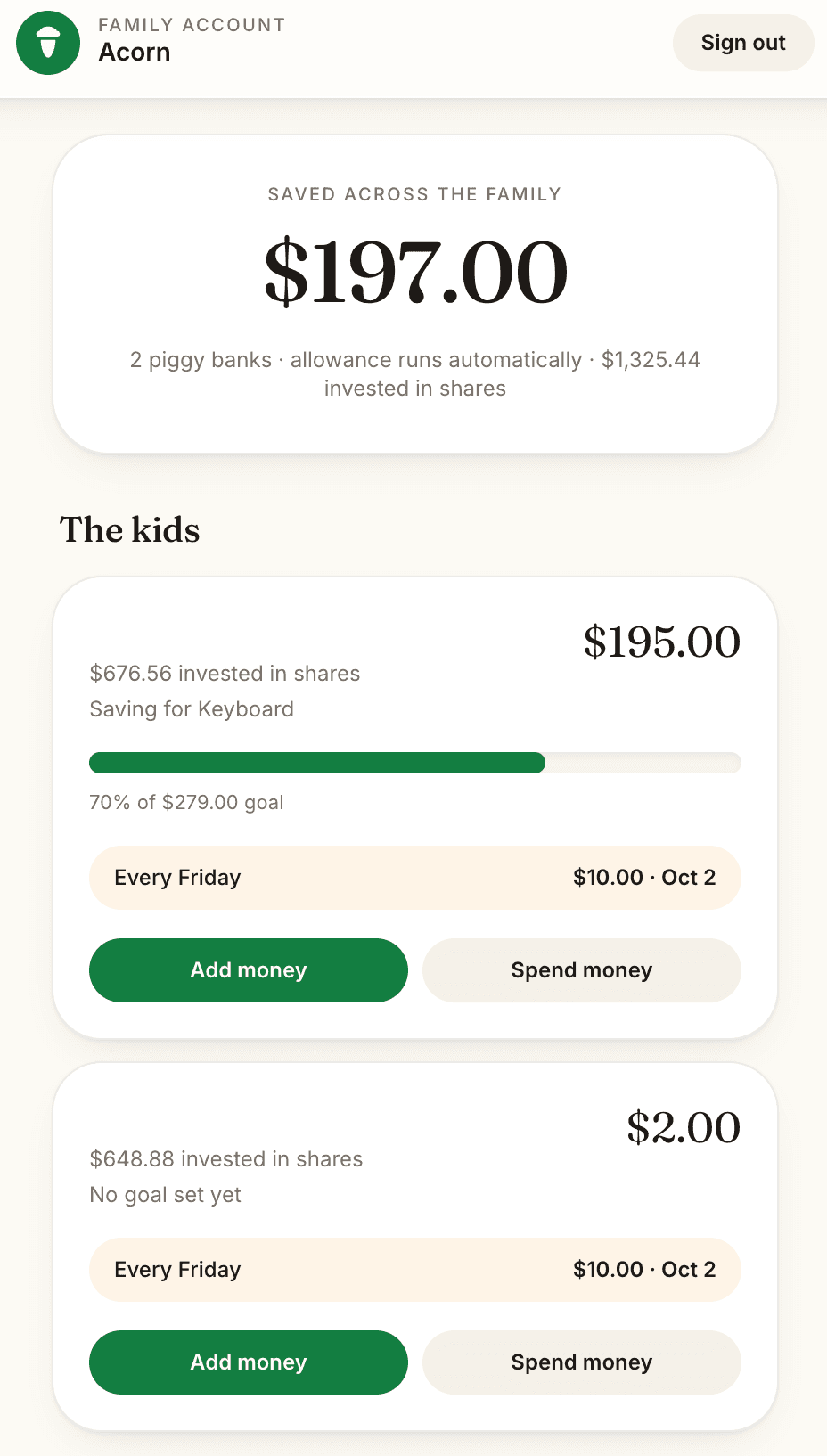
Acorn is a simple family banking app for managing our kids' allowances, spending, savings goals and investments. It's a personal project, built with Lovable in August 2026, and our family uses it all the time.
The problem
Giving our kids a regular allowance sounded simple. Keeping track of it wasn't.
With two children receiving regular payments, spending money at different times, saving toward different things and building up investments, it got harder and harder to answer a very basic question: how much money does each child actually have?
I wanted something that worked more like a tiny family bank than a chore chart or a spreadsheet. So I built Acorn.
What I built
Acorn is a private family finance tracker that gives each child their own financial picture. It adds their regular allowance automatically, and lets us record purchases and other transactions as they happen.
Instead of mentally keeping track of who has spent what, there's one place to manage it.
Key features
- Current balance
- Each child's own balance, plus a total across the family.
- Automatic allowance
- Recurring payments on a set day, with the next one shown.
- Spending history
- Purchases recorded and deducted as they happen.
- Savings goals
- Something to save for, with progress toward it.
- Investment balance
- Money invested for the future, kept separate from spending money.
Interesting problems
Automating allowance
Allowance is predictable, so it shouldn't depend on us remembering to add money to two balances every time it's due. Acorn handles recurring payments automatically while individual purchases are deducted as they happen. That's what makes the balance in the app the family's source of truth, rather than another record that needs keeping up to date by hand.
Making saving visible
I didn't want to just show the kids a number. Savings goals make the link between earning, spending and saving visible. Instead of “you have $80”, the conversation becomes “you have $80, and you're $20 away from the thing you're saving for.”
Including investments
The kids also have investments, a category of money that doesn't fit neatly into a basic allowance tracker. Acorn tracks them separately, so we can see both the money available now and the money being built up for the future. That turned it from an allowance tracker into a small overview of each child's finances.
Building for real use
Acorn wasn't built to attract users or become a product. The user research was considerably easier: the users live in my house. If something creates unnecessary work, doesn't make sense at a glance, or doesn't reflect how we actually handle the kids' money, I run into it myself.
Decisions & trade-offs
Keep the transaction model simple
It isn't meant to teach children double-entry bookkeeping. Money comes in, money goes out, and the balance has to be immediately understandable.
Automate predictable activity
Recurring allowance shouldn't rely on someone remembering to update the app. Automating it removes one of the main reasons manual tracking eventually drifts out of date.
Separate spending from long-term money
Available money, savings goals and investments are different things. Showing them separately makes the whole picture easier to understand while keeping it all in one place.
Build for the actual users
As a personal family tool, it doesn't need features just because a conventional finance app would have them. The goal was something useful for four specific people.
Outcome
Acorn replaced an awkward manual process with a small family banking system built around how we actually manage our children's money. It handles allowance automatically, records spending, tracks savings goals and keeps their investments visible in one place.
It's a relatively small app, and that's exactly what I like about it: a recurring real-world annoyance turned into software that removes it.
What I learned
Acorn reinforced that useful software doesn't need a large audience. Sometimes the best reason to build something is simply: “we keep having this problem.”
It was also another chance to use AI-assisted development as a practical tool: start with a real workflow, define how it should behave, build a working version, then refine it through everyday use. It isn't a demo or a hypothetical portfolio piece. It's software my family actually uses.
Tech
- Lovable
- AI-assisted development